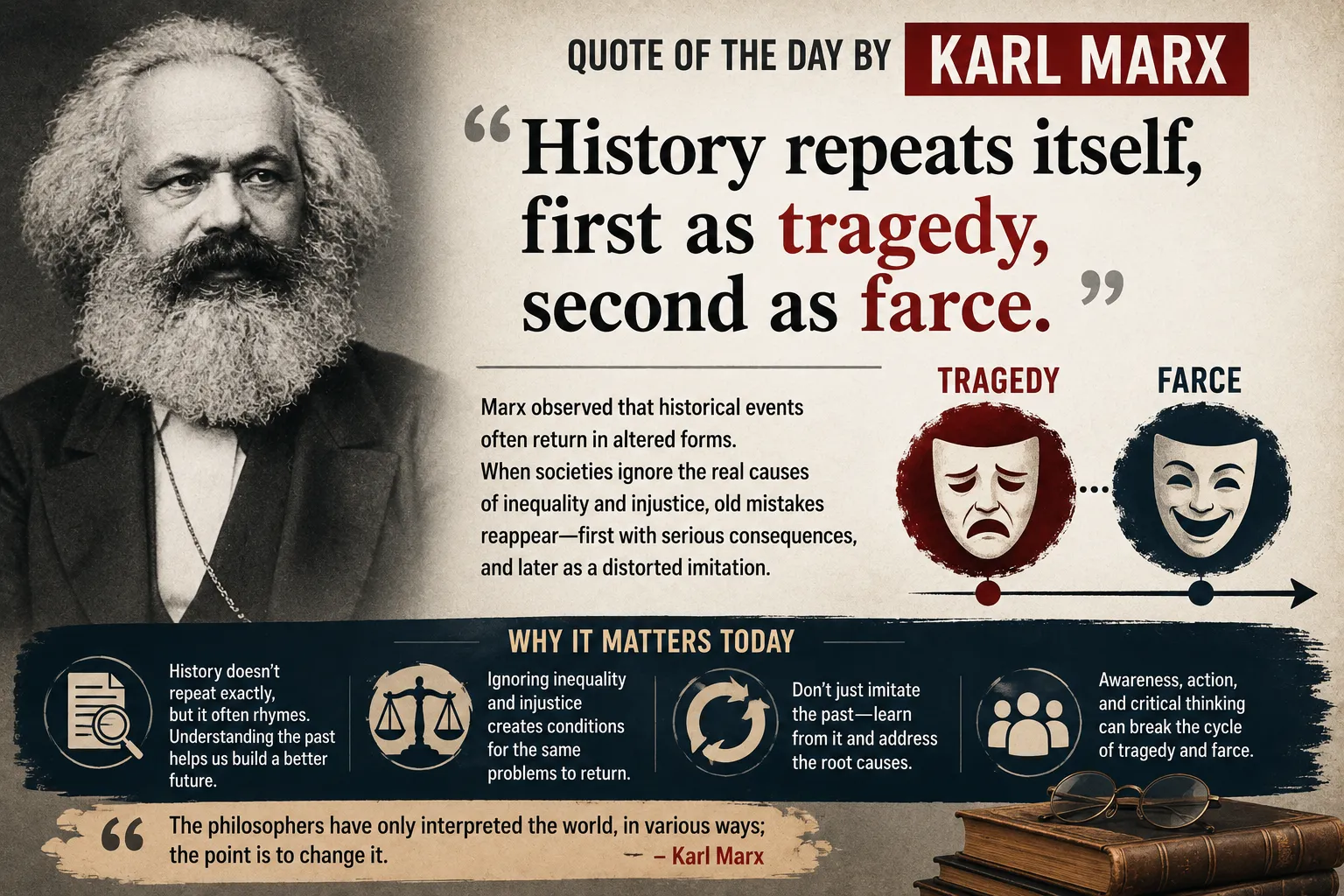
Few quotations in political philosophy have been cited as frequently as Karl Marx’s observation: “History repeats itself, first as tragedy, second as farce.” Though often quoted in discussions about politics, economics, and social change, the statement is frequently used without understanding its original context. Far more than a clever remark, the quote reflects Marx’s analysis of how societies respond to recurring political crises and why historical patterns often reappear in altered forms.
Originally written in The Eighteenth Brumaire of Louis Bonaparte (1852), the phrase was Marx’s commentary on political events in France following the revolutions of the nineteenth century. He argued that history does not literally repeat itself in identical ways. Instead, later generations often imitate the symbols, language, and institutions of the past while failing to resolve the deeper problems that caused earlier crises. As a result, what was once a serious historical tragedy may later return in a less convincing or even absurd form.
More than 170 years after it was written, the quote continues to be referenced whenever societies appear to repeat political, economic, or social mistakes. Its enduring relevance lies in its reminder that meaningful progress requires learning from history rather than merely recreating its appearance.
The Origin of the Famous Quote
Karl Marx wrote the statement in his political essay The Eighteenth Brumaire of Louis Bonaparte, published in 1852.
The essay examined the rise of Louis-Napoléon Bonaparte, who became President of France and later declared himself Emperor Napoleon III. Marx compared these events with the earlier rule of Napoleon Bonaparte, arguing that the later political developments imitated the past but lacked the same historical significance.
At the beginning of the essay, Marx referred to the German philosopher Georg Wilhelm Friedrich Hegel, noting that Hegel had observed how major historical events and figures often appear twice. Marx then added his own famous interpretation: “The first time as tragedy, the second time as farce.”
This addition became one of the most quoted observations in political thought.
What Does “First as Tragedy” Mean?
The first part of the quote refers to genuinely significant historical events.
A tragedy involves serious human consequences—political upheaval, conflict, revolution, economic collapse, or social transformation. These events shape societies because they arise from real struggles, competing ideas, and structural problems.
According to Marx, historical tragedies often emerge from deep inequalities, political tensions, or failures within existing systems.
Such moments carry lasting consequences because they fundamentally alter the direction of history.
Understanding “Second as Farce”
The second half of the quotation is often misunderstood.
Marx did not suggest that history simply repeats itself identically. Instead, he argued that later political leaders sometimes imitate the symbols, language, or behaviour of earlier historical figures without addressing the underlying issues that originally produced change.
As a result, the later version may appear theatrical, exaggerated, or ineffective—a “farce.”
In other words, people attempt to recreate history’s appearance while ignoring its substance.
The repetition becomes superficial rather than transformative.
Why Marx Believed History Appears to Repeat
Marx viewed history as being driven by economic conditions, class relations, and social structures rather than by individual personalities alone.
When societies fail to resolve fundamental inequalities, similar tensions may emerge again under different circumstances.
Although the people, institutions, and technologies change, unresolved social and economic pressures can create familiar patterns.
The repetition, however, is never exact.
Each historical period develops within its own unique political, cultural, and economic environment.
The Role of Social and Economic Inequality
One of Marx’s central arguments was that persistent inequality creates recurring instability.
When wealth, political influence, or economic opportunity remain concentrated among relatively few groups, dissatisfaction may gradually increase.
If governments fail to address these structural issues, societies may experience repeated cycles of unrest, reform movements, or political realignment.
While specific circumstances differ across countries and historical periods, Marx believed that ignoring underlying problems often allows similar conflicts to reappear.
This broader principle explains why his writings continue to influence discussions about economics and politics.
Why the Quote Remains Relevant Today
The quotation continues to appear in modern political commentary because many observers believe certain historical patterns recur across generations.
Economic crises, financial instability, political polarization, social inequality, institutional challenges, and debates over democracy often prompt comparisons with earlier historical periods.
Writers, historians, economists, and political analysts frequently invoke Marx’s words when discussing situations that appear to repeat familiar mistakes.
However, responsible use of the quote requires recognizing that historical similarities should not be treated as proof that identical outcomes will occur.
History offers lessons, not precise predictions.
Beyond Politics: Lessons for Society
Although originally written about French politics, the quotation has broader applications.
Organizations, businesses, institutions, and even individuals sometimes repeat previous mistakes because they focus on immediate symptoms rather than root causes.
For example, financial crises may expose weaknesses in regulation, corporate governance, or market behaviour.
If reforms remain superficial, similar problems can eventually return in new forms.
The same principle applies to public policy, education, environmental management, and organizational leadership.
Addressing fundamental causes generally proves more effective than repeating familiar responses.
Common Misinterpretations
Because the quote is widely circulated online, it is often taken out of context.
Some people mistakenly believe Marx meant that every historical event inevitably repeats itself.
Others interpret the phrase as suggesting that history follows fixed cycles.
Neither interpretation accurately reflects his argument.
Marx emphasized that history develops through changing material conditions and human action.
Repetition occurs because societies sometimes recreate familiar circumstances without resolving underlying structural problems.
Each recurrence therefore differs from the original event.
Why History Still Matters
Studying history provides societies with opportunities to recognize recurring challenges before they become crises.
Historical knowledge encourages critical thinking rather than blind imitation.
It helps policymakers evaluate previous successes and failures, citizens understand institutional development, and leaders make more informed decisions.
Ignoring historical experience does not guarantee repeated mistakes, but understanding history can improve the quality of public debate and long-term planning.
Marx’s quotation encourages exactly this type of historical awareness.
The Continuing Influence of Karl Marx
Whether one agrees with his political philosophy or not, Karl Marx remains one of history’s most influential thinkers.
His writings shaped discussions on economics, labour, capitalism, class relations, and political power throughout the nineteenth and twentieth centuries.
Universities around the world continue studying his work across disciplines including economics, sociology, history, political science, and philosophy.
Many concepts introduced by Marx remain important reference points in academic research, even among scholars who disagree with his conclusions.
His famous quotation endures because it captures a broader truth about the importance of learning from historical experience.
Applying the Quote in Everyday Life
The message behind the quotation extends beyond governments and revolutions.
Individuals also benefit from examining recurring patterns in their own decisions.
Repeated financial mistakes, workplace conflicts, ineffective leadership styles, or unsuccessful habits often arise because underlying causes remain unaddressed.
Meaningful improvement requires identifying root problems rather than merely changing appearances.
This practical lesson explains why the quotation continues to resonate with readers from many different backgrounds.
A Reminder to Learn, Not Imitate
Perhaps the greatest value of Marx’s observation lies in its warning against superficial repetition.
Societies frequently celebrate historical symbols, anniversaries, slogans, and traditions.
Yet genuine progress depends less on repeating historical imagery than on understanding why previous generations succeeded or failed.
Learning from history requires analysis rather than nostalgia.
Only by addressing structural challenges can societies avoid recreating familiar problems under new circumstances.
Conclusion
Karl Marx’s famous observation that “history repeats itself, first as tragedy, second as farce” remains one of the most enduring quotations in political and historical thought. Written in the context of nineteenth-century France, it continues to inspire discussion because it highlights a recurring tendency among societies to imitate the past without resolving the deeper issues that originally caused conflict or change. Rather than predicting identical historical cycles, Marx emphasized that repeated mistakes often arise when fundamental economic, political, or social problems remain unaddressed.
Today, the quotation serves as both a historical insight and a practical reminder. Whether applied to politics, economics, organizations, or personal decision-making, its central message remains relevant: lasting progress depends not on recreating history’s outward appearance but on understanding and addressing its underlying causes. By learning from the past instead of merely repeating it, societies and individuals alike can make more informed choices about the future.
islamicduahub islamicduahub islamicduahub islamicduahub islamicduahub islamicduahub islamicduahub islamicduahub islamicduahub islamicduahub islamicduahub islamicduahub islamicduahub islamicduahub islamicduahub islamicduahub islamicduahub islamicduahub islamicduahub islamicduahub islamicduahub islamicduahub islamicduahub islamicduahub islamicduahub islamicduahub islamicduahub islamicduahub islamicduahub islamicduahub islamicduahub islamicduahub islamicduahub islamicduahub islamicduahub islamicduahub islamicduahub islamicduahub islamicduahub islamicduahub islamicduahub islamicduahub islamicduahub islamicduahub islamicduahub islamicduahub islamicduahub islamicduahub islamicduahub islamicduahub islamicduahub islamicduahub islamicduahub islamicduahub islamicduahub islamicduahub islamicduahub islamicduahub islamicduahub islamicduahub islamicduahub islamicduahub islamicduahub islamicduahub islamicduahub islamicduahub islamicduahub islamicduahub islamicduahub islamicduahub islamicduahub islamicduahub islamicduahub islamicduahub islamicduahub islamicduahub islamicduahub islamicduahub islamicduahub islamicduahub islamicduahub islamicduahub islamicduahub islamicduahub islamicduahub islamicduahub islamicduahub islamicduahub islamicduahub islamicduahub islamicduahub islamicduahub islamicduahub islamicduahub islamicduahub islamicduahub islamicduahub islamicduahub islamicduahub islamicduahub islamicduahub islamicduahub islamicduahub islamicduahub islamicduahub islamicduahub islamicduahub islamicduahub islamicduahub islamicduahub islamicduahub islamicduahub islamicduahub islamicduahub islamicduahub islamicduahub islamicduahub islamicduahub islamicduahub islamicduahub islamicduahub islamicduahub islamicduahub islamicduahub islamicduahub islamicduahub islamicduahub islamicduahub islamicduahub islamicduahub islamicduahub islamicduahub islamicduahub islamicduahub islamicduahub islamicduahub islamicduahub islamicduahub islamicduahub islamicduahub islamicduahub islamicduahub islamicduahub islamicduahub islamicduahub islamicduahub islamicduahub islamicduahub islamicduahub islamicduahub islamicduahub islamicduahub islamicduahub islamicduahub islamicduahub islamicduahub islamicduahub islamicduahub islamicduahub islamicduahub islamicduahub islamicduahub islamicduahub islamicduahub islamicduahub islamicduahub islamicduahub